
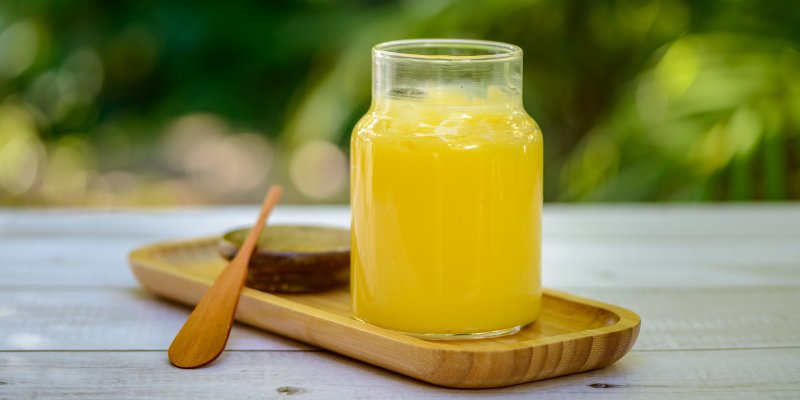
In Indian sweet-making, ghee is not an ingredient — it is the ingredient. The quality of the ghee determines the quality of every sweet it touches. Understanding the difference between genuine cow ghee and its substitutes is the single most useful thing a sweet buyer can learn.
What Pure Cow Ghee Actually Is
Cow ghee is clarified butter made from cow's milk — heated slowly until the water evaporates and milk solids separate, leaving pure butterfat. Traditional methods use the bilona (churning) process: curd is hand-churned to extract butter, which is then slow-heated into ghee. This produces a granular texture and a deep, nutty aroma that industrial centrifuge methods cannot replicate. Our Pure Cow Ghee follows this traditional approach.
Ghee vs. Vegetable Oil in Sweets
The substitution is the most common quality compromise in the Indian sweets industry:
- Flavour — Ghee adds a warm, rounded nuttiness. Vegetable oil is flavour-neutral at best, slightly rancid at worst.
- Texture — Ghee-based sweets have a clean melt and no greasy residue. Oil-based sweets feel heavy and leave a coating on the palate.
- Aroma — Ghee has a distinctive, immediately recognisable smell when heated. Oil has none.
- Shelf life — Ghee is a natural preservative with antimicrobial properties. Oil-based sweets often require synthetic preservatives.
How to Identify Real Ghee in Sweets
The Smell Test
Open the box. Genuine ghee-based sweets have a warm, dairy aroma — unmistakable. If there is no dairy smell, or if it smells neutral/chemical, the ghee has been partially or fully substituted.
The Melt Test
Place a piece on your palm. Ghee-based sweets begin to soften from body heat alone. Oil-based sweets remain firm longer and feel waxy.
The Ingredient List
Look for "cow ghee" or "desi ghee" in the ingredients. "Edible vegetable fat," "hydrogenated fat," or "vanaspati" are substitutes. If the ingredient list does not specify, assume the worst.
Ghee in Specific Lynk Products
Every Lynk sweet uses pure cow ghee — here is where it makes the biggest difference:
- Mysore Pak — Ghee is nearly 50% of the recipe. The melt-crumble texture is entirely ghee-dependent.
- Motichoor Ladoo and Boondi Ladoo — The boondi is fried in ghee, making it the frying medium. Every pearl carries the flavour.
- Kaju Katli — Ghee binds the cashew paste. It determines whether the katli is clean-tasting or oily.
- Besan Ladoo — Roasted in ghee, the besan develops a complex nutty flavour impossible with oil.
Buying Ghee for Home Use
If you make sweets at home, the ghee quality determines your ceiling. Our Pure Cow Ghee is available in the Ghee collection — single-origin, traditionally processed, suitable for both cooking and direct sweet-making.
Frequently Asked Questions
How can I tell if my ghee is pure?
Pure cow ghee has a granular texture when solidified, a warm golden colour, and a distinctive dairy aroma. It melts cleanly at body temperature. Adulterated ghee may be uniformly smooth, pale, or odourless.
Is ghee healthier than butter?
Ghee has a higher smoke point than butter and contains no lactose or casein (removed during clarification). It is rich in fat-soluble vitamins A, D, E, and K, and contains conjugated linoleic acid (CLA).
Why is ghee so expensive?
It takes approximately 25 litres of milk to produce 1 kg of ghee through traditional methods. This yield ratio, plus the time-intensive bilona process, accounts for the cost.
Does Lynk use ghee in all its sweets?
Yes. Every Lynk product is made with pure cow ghee — no vegetable oil, no vanaspati, no blending.