
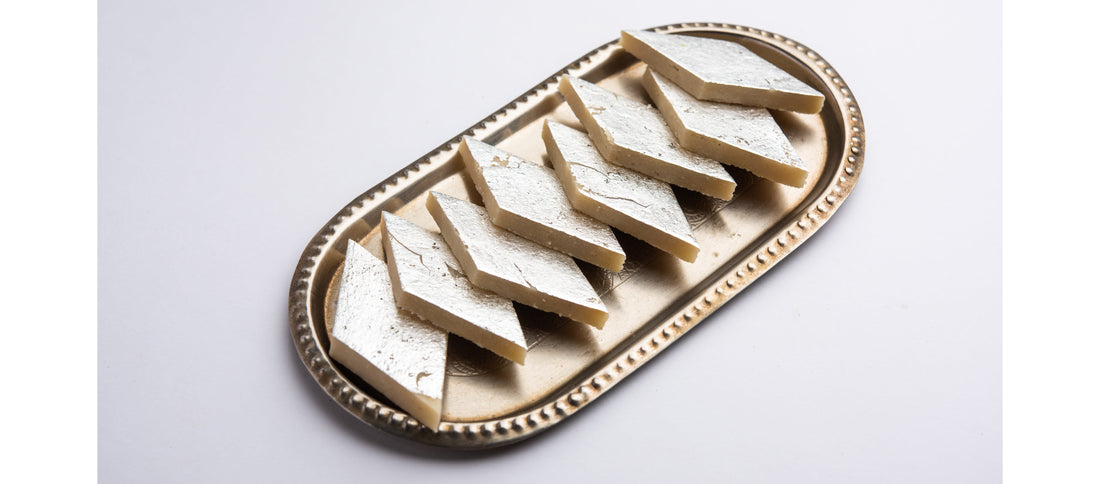
Badam Katli is Kaju Katli's quieter sibling — less commonly gifted but arguably more interesting to eat. The almond base creates a different density, a different sweetness, and a different nutritional profile. Here is what makes it worth knowing.
The Almond Difference
Where Kaju Katli uses cashew paste for its smooth, melt-on-tongue quality, Badam Katli uses almond paste — which is denser, slightly grainier, and nuttier. Almonds have a more complex flavour than cashews: they are earthier, slightly bitter in the skin, and carry a roasted depth when blanched and ground. This makes Badam Katli a more texturally interesting sweet for those who appreciate nuance.
Almond Quality and Its Impact
Not all almonds produce the same katli. The key variables:
- Blanching — Skins must be fully removed. Any remaining skin creates brown flecks and a bitter undertone.
- Grinding fineness — The almonds must be ground to a paste, not a powder. Too coarse and the katli crumbles; properly ground and it slices cleanly like Kaju Katli.
- Oil release — Almonds release natural oil during grinding. This is desirable — it creates the binding. Over-grinding releases too much, making the katli greasy.
Badam Katli vs. Kaju Katli: A Direct Comparison
| Attribute | Kaju Katli | Badam Katli |
|---|---|---|
| Base nut | Cashew | Almond |
| Texture | Smooth, melting | Slightly dense, grainy |
| Flavour | Mild, buttery | Nutty, earthy |
| Sweetness | Moderate | Slightly less sweet |
| Nutritional edge | None specific | Higher protein, vitamin E, fibre |
| Gifting appeal | Universal | Connoisseur choice |
Nutritional Profile
Badam Katli carries genuine nutritional value that distinguishes it from sugar-heavy sweets:
- Protein — Almonds provide roughly 21g protein per 100g, making Badam Katli one of the most protein-rich Indian sweets.
- Vitamin E — A powerful antioxidant. Almonds are one of the richest natural sources.
- Healthy fats — Primarily monounsaturated fats, the same type found in olive oil.
- Fibre — Higher fibre than most sweets, contributing to slower sugar absorption.
When to Choose Badam Katli
- For health-conscious recipients — The almond base makes it a defensible indulgence.
- For variety in a gift box — Pair with Kaju Katli for a katli duo that covers different nut profiles.
- For those who find Kaju Katli too mild — The earthier almond flavour provides more character.
- For winter gifting — Almonds are traditionally considered warming foods in Ayurvedic practice.
Browse our Katli collection for both almond and cashew katli options.
How to Judge Quality
- Colour — Should be off-white to pale gold. Bright white suggests excessive processing; yellow suggests stale almonds.
- Cut precision — Same standard as Kaju Katli: uniform diamonds, consistent thickness, clean edges.
- Silver leaf — Should be smooth and even. Patchy or absent silver leaf indicates cost-cutting.
- Break test — Snap a piece in half. It should break cleanly, not crumble or bend. The cross-section should show dense, uniform almond paste.
Frequently Asked Questions
Is Badam Katli better than Kaju Katli?
Neither is objectively better — they serve different preferences. Badam Katli is denser, nuttier, and more protein-rich. Kaju Katli is smoother, milder, and more universally liked. Both have their place.
How is Badam Katli made?
Blanched almonds are ground to a fine paste, combined with sugar syrup and ghee, cooked to the right consistency, rolled thin, covered with silver leaf, and diamond-cut.
Is Badam Katli healthy?
Compared to most sweets, yes — almonds provide protein, vitamin E, healthy fats, and fibre. It is still a sweet with sugar and ghee, so moderation applies, but the nutritional density is genuinely higher.
What is the shelf life of Badam Katli?
15–20 days at room temperature when properly sealed. Refrigeration extends this to 3–4 weeks. MAP packaging maintains freshness during transit.